
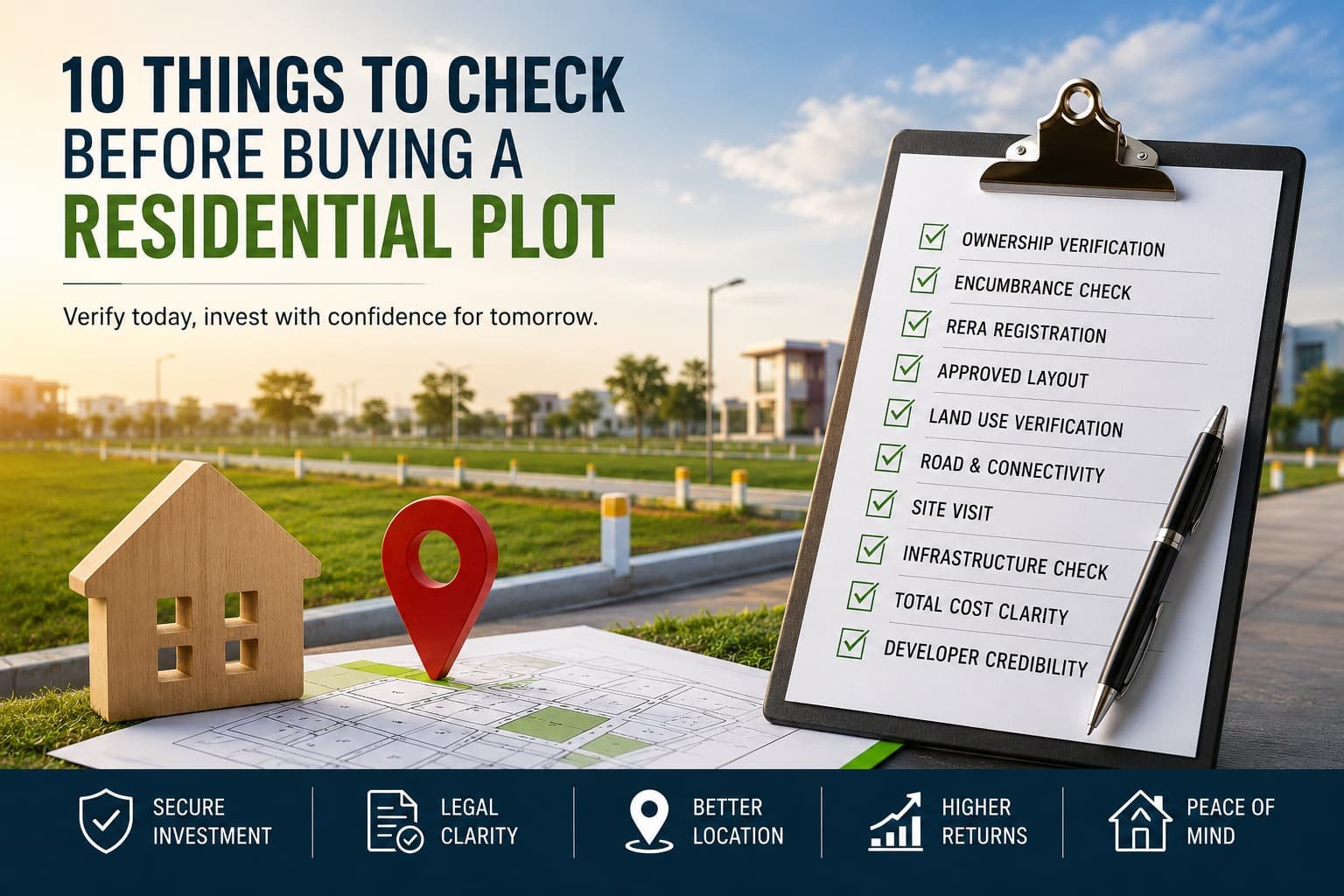
A plot may look perfect at first glance: a good location, an attractive price, a beautiful entrance and a convincing brochure. But buying land is a major financial decision, and the details you ignore today can become expensive problems later.
Before paying a booking amount, do not focus only on “Kitne ka hai?” Ask the more important question: “Exactly what am I buying, and is everything properly verified?”
This simple checklist will help you make a more confident and informed plot-buying decision.
Whether you are buying a plot for your future home, as a long-term investment or for your family, the process should be the same: first understand the property, then verify the facts and only after that make a financial commitment. A good property decision is rarely about speed; it is about clarity.
First, confirm who legally owns the land and whether the seller or developer has the full right to sell it. Ask for the title deed, sale deed, ownership chain and other relevant documents. Do not rely only on verbal assurance that the papers are clear.
If ownership is unclear, do not move forward until it is properly verified.
Also check whether the person signing the agreement is the actual owner or an authorised representative. If someone is selling on behalf of another person, ask for the authority documents. Small gaps in ownership paperwork should never be ignored simply because the deal appears attractive.
A property can have ownership documents and still carry a bank loan, legal dispute, charge or another registered claim. Ask for an encumbrance certificate and check whether any third party has an interest in the land.
If you are not comfortable reading legal documents, take advice from a qualified property lawyer before making any payment.
This check is especially important before paying a token amount. Even if the amount feels small, your payment should be supported by clear written terms that explain what happens if the documents are not found satisfactory.
If the plotted project falls under RERA, ask for its registration number and verify it on the relevant state RERA website. Check the project name, promoter details, registration status, approved layout and declared development information.
RERA is not just a marketing label; it is an important verification step.
RERA information can help you compare what has been officially declared with what is being communicated during the sale. It is still wise to review the project documents independently, because every buyer’s purpose, plot selection and transaction details can be different.
The layout shown in a brochure should match the approved plan. Verify plot number, plot dimensions, internal road width, open spaces, parks, common areas, entry points and reserved areas. An attractive master plan is useful, but the approved layout is what matters legally.
Ask the sales team to mark your exact plot on the approved layout and confirm its dimensions in writing. This helps you avoid confusion later about the plot position, road-facing side, corner status or nearby common area.
Do not assume that every piece of land can automatically be used for a house. Confirm that the land is legally suitable for residential use and that the necessary conversion, permissions and approvals are in place.
Land and a legally valid residential plot are not always the same thing.
It is also important to understand whether any restrictions apply to construction, building height, usage or access. Your future plan may be to build a house, but that plan should match the rules applicable to the land.
A location pin can make a project look close to everything. Visit the site and check the existing approach road, road width, connectivity to major roads and the condition of the route in different seasons.
Also understand the difference between an existing operational road and a proposed road. Proposed infrastructure may be valuable in the future, but it should not be treated as something already available today.
When you visit, do not only follow the route suggested by the salesperson. Check the route independently on a map and observe how comfortably your family, visitors, construction vehicles and emergency services could reach the site.
Never finalise land only through WhatsApp photos, videos or a brochure. Walk around the project and observe the surrounding area. Check nearby development, occupied properties, road condition, utilities, access and the general environment.
A site visit is where the brochure meets reality. If possible, visit more than once and at different times of the day.
During the visit, ask to see the exact plot boundaries. A site map is helpful, but physically seeing the plot gives you a much better understanding of its surroundings, shape, level and approach.
Ask clearly about electricity, water, drainage, internal roads, street lighting, security, parks and common areas. Then ask one more question: Is it already available, under development or only proposed?
These three stages are very different. Make your decision based on what is verified, not only on future promises.
For every promised facility, ask for the expected completion stage and written confirmation wherever possible. This is particularly useful for buyers who want to construct their home soon and need practical access to water, electricity and roads.
The quoted plot price is rarely the final amount you will pay. Ask for a written cost sheet that includes registration and stamp charges, development charges, maintenance, taxes, financing cost and any project-specific fees.
The right question is not “Which plot is cheapest?” It is “What will this complete decision cost me?”
Compare two projects only after comparing their complete cost sheets. A lower base price can sometimes become less attractive after additional charges are included. Written clarity protects both the buyer and the developer.
Look beyond the current project and research the developer. Review previous projects, delivery record, documentation quality, customer experience and transparency during the sales process. A developer’s past work often tells you more than a polished presentation.
RERA registration is important, but it does not replace your own due diligence.
Talk to existing customers where possible and visit completed projects by the same developer. Notice the road quality, maintenance, delivered amenities and overall execution. Real experience is often more useful than promotional claims.
Property buyers often hear phrases such as “last few plots”, “offer ends tonight” or “price will increase tomorrow”. Availability and price can genuinely change, but urgency alone should never replace verification.
A sound opportunity can be explained through documents, location, access, development status and total cost. If you need a little time to understand the property, take that time. A booking decision made with clarity is far better than one made under pressure.
There is no benefit in pretending to understand a legal document that feels confusing. Consult a qualified property lawyer when ownership records, approvals, the sale agreement, land use or payment terms are unclear. A small professional fee can be far less expensive than solving a dispute later.
You can also ask an experienced surveyor or architect for advice when plot measurements, boundaries, site level or future construction feasibility matters to your plan.
| Check | Question to Ask |
|---|---|
| Ownership | Who legally owns the land? |
| Approvals | Are the required approvals and layout documents available? |
| RERA | Have I verified the registration, where applicable? |
| Access | What road actually connects the site? |
| Cost | What is the complete cost including all charges? |
| Developer | Can I verify their past projects and claims? |
Buying a plot should not be a rushed decision. Take time to understand the documents, inspect the location, verify the development and calculate the complete cost. A few hours spent checking the right details can save years of stress later.
Understand → Verify → Evaluate → Decide
At Siddham Infra Projects, we believe land ownership should come with clarity and confidence. Our aim is to help buyers understand the location, verify the important details and choose a property that genuinely fits their purpose.
Do not buy because of pressure. Buy because you understand the decision.