
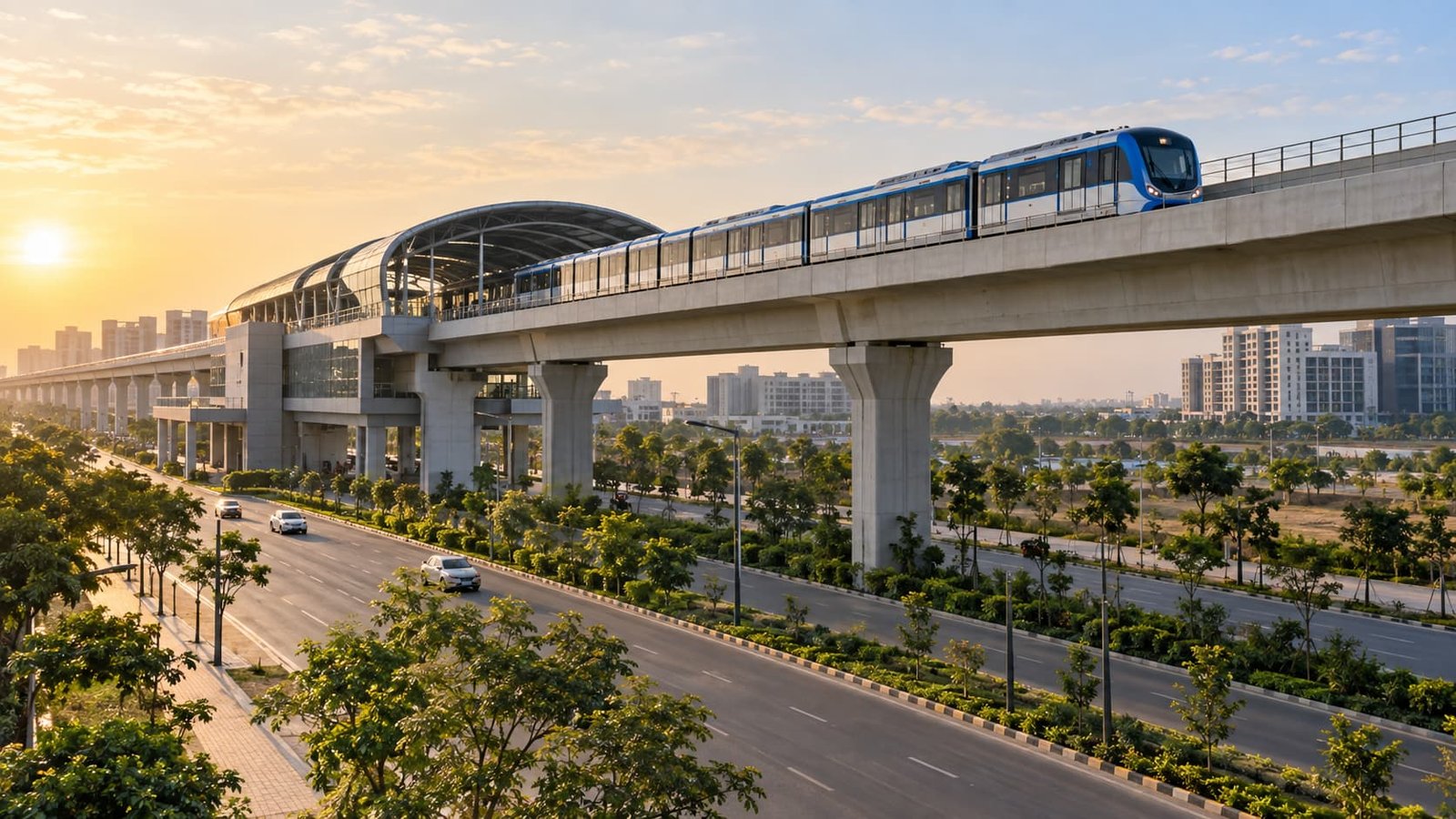
For years, “Metro aa rahi hai” has been one of the most common phrases in Indian real estate. It appears in brochures. It appears in sales conversations. It appears on property listings. But there is a big difference between: Metro proposed and Metro operational. As of September 2026, Indore has crossed that second threshold. On 5 September 2026, the newly developed approximately 11-km Priority Corridor-2 section from Super Corridor-3 to Malviya Nagar Chauraha was inaugurated. With the extension, Indore’s operational metro network has reached approximately 17 km and 16 stations. Commercial passenger service began on 6 September 2026. (Press Information Bureau) That is a meaningful change. But here’s the question property buyers should ask: Does a working Metro automatically mean property prices will rise? No. And that’s exactly why this is worth understanding.
What Has Actually Changed?
The earlier operational stretch connected Gandhi Nagar with Super Corridor-3. The latest expansion extends the operational network toward Malviya Nagar Chauraha, connecting more residential, commercial and employment areas. (Telangana Today) The new corridor was developed at an estimated cost of ₹2,850 crore, and the overall operational network now covers around 17 km. (Press Information Bureau) This changes something important: Connectivity has moved from promise to daily utility. People can now actually use the system. That matters because infrastructure becomes economically meaningful when people use it.
But Don’t Make the Classic Real-Estate Mistake
Suppose a property is: 2 km from a metro station. Is that automatically a great investment? Not necessarily. You still need to ask:
- Is the route convenient?
- Is the property actually walkable or easily connected?
- What is the road access?
- What employment centres are nearby?
- What residential demand exists?
- What social infrastructure exists?
- Is the surrounding development happening?
- What is the legal status of the property?
- What is the total acquisition cost?
Metro is one signal. It isn’t the entire investment thesis.
The 4-Layer Metro Test
Instead of asking: “Metro kitni door hai?” Try this framework.
Layer 1 — Physical Distance
How far is the property from the station? Don’t rely only on a map. Check actual road distance.
Layer 2 — Travel Convenience
A property may be 2 km away but connected by a poor internal road. Another may be slightly farther but have much easier access. So measure: Actual travel time > headline distance
Layer 3 — Economic Connectivity
Ask: “Where can this Metro take people?” The value of public transport isn’t simply the station. It’s the network. The latest extension connects residential and commercial areas and employment hubs, which is why the government has described the expansion as an urban-mobility and economic-development project rather than merely a transport project. (Press Information Bureau)
Layer 4 — Surrounding Development
This is the layer property buyers often forget. Metro + jobs + roads + housing + schools + healthcare + retail is a very different ecosystem from: Metro station + empty land. Infrastructure creates opportunity. But the surrounding ecosystem determines how useful that opportunity becomes.
So What Should a Property Buyer Watch Now?
1. Actual Metro usage
Now that the route is operational, observe how people use it.
2. Station-level development
Look at what starts developing around important stations.
3. Employment connectivity
Which employment hubs become easier to reach?
4. Residential demand
Does improved connectivity make an area more convenient for actual residents?
5. Commercial activity
Are businesses beginning to follow the improved connectivity? These are more meaningful signals than simply counting stations.
What Metro Does NOT Tell You
Metro cannot tell you:
- whether a plot has clear title
- whether a project is legally approved
- whether the price is reasonable
- whether the surrounding development will happen at the expected speed
- whether your investment horizon is appropriate
- whether the property suits your financial goal
So: Metro improves a location’s connectivity. It doesn’t certify a property. That’s an important distinction.
A Simple Example
Imagine two plots.
Plot A
- 2 km from Metro
- unclear access
- weak surrounding development
- questionable documentation
Plot B
- 3 km from Metro
- strong road access
- established residential ecosystem
- clear documentation
- nearby employment and social infrastructure
Which one would you investigate first? The answer shouldn’t automatically be Plot A. Because: Location quality is bigger than one infrastructure feature.
What the New Metro Should Change in Your Property Research
Before the Metro became operational, a buyer could ask: “Will this connectivity happen?” Now the question can become: “How is this connectivity changing actual movement and urban activity?” That is a much better investment question. And over time, it can help buyers understand which locations are becoming more connected in practice, rather than simply being marketed as future growth zones.
5 Questions to Ask Before Buying Near a Metro Corridor
1. How far is the property by actual road travel?
2. What employment hubs can the Metro realistically connect me to?
3. What is already developed around the property?
4. What infrastructure is operational versus merely proposed?
5. Does the property still make financial sense without assuming future appreciation?
That last question is especially important. If your entire investment thesis depends on property prices doubling, you don’t have a thesis. You have a prediction.
The Bigger Indore Story
The Metro expansion is only one part of Indore’s broader infrastructure story. The city’s long-term transport planning also includes ambitions to connect major transit hubs and expand the network toward other regional centres. The Indore–Manmad railway project is another major connectivity development aimed at strengthening regional links and improving access to the Pithampur industrial area. (The Times of India) But again: Planned infrastructure should be treated differently from operational infrastructure. That distinction should become a standard part of every property buyer’s research.
Final Takeaway
The most important change isn’t that Indore now has 17 km of operational Metro. It’s that property buyers can now start studying real usage and real connectivity rather than relying only on future promises. So if you’re evaluating a property near an emerging corridor, don’t ask only: “Metro hai kya?” Ask: “How does this Metro change the actual usefulness of this location?” That’s where the real property analysis begins.
Siddham’s Perspective
At Siddham, we believe infrastructure should be understood, not exaggerated. A road, Metro line or employment hub can influence how a location evolves — but every property still deserves its own evaluation. Study the connectivity. Study the development. Study the documents. Then make the decision. Because good property decisions are built on evidence, not excitement.
Frequently Asked Questions
Does Metro increase property prices?
Metro can improve accessibility and influence how a location develops, but it does not guarantee property-price appreciation.
How long is Indore Metro operational now?
The operational network is approximately 17 km across 16 stations after the September 2026 expansion. (Press Information Bureau)
Is property near a Metro station always a good investment?
No. Buyers should also evaluate access, employment, surrounding development, legal clarity, price and demand.
Is Super Corridor connected to Indore Metro?
Yes. The operational network includes the Super Corridor section and the September 2026 extension from Super Corridor-3 toward Malviya Nagar Chauraha. (Press Information Bureau)
What is more important: Metro distance or road connectivity?
Both matter. Actual travel convenience should be evaluated rather than relying only on straight-line distance.
Should I buy property because Metro has started?
Not by itself. Metro should be treated as one part of a broader location and investment analysis.