
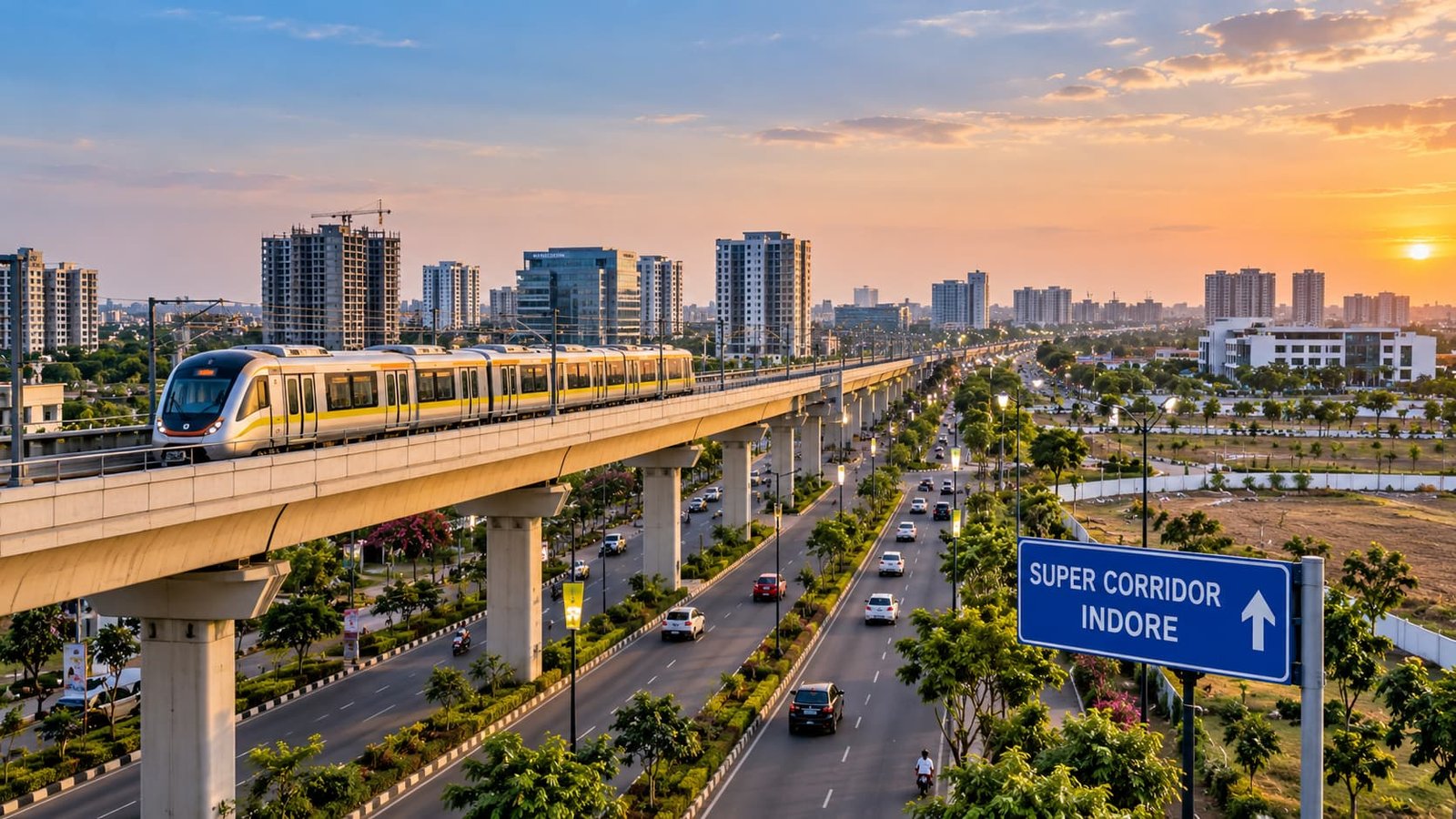
The Indore Metro has changed from a future infrastructure promise into something property buyers can actually evaluate.
There is a major difference between:
“Metro is coming.”
and
“Metro is operating.”
For Indore’s property market—and particularly the Super Corridor—that distinction matters.
In September 2026, the operational Indore Metro network expanded to approximately 17 km and 16 stations, including connectivity through the Super Corridor.
But does that mean every nearby property automatically became a better investment?
No.
It means buyers now have a piece of operational infrastructure that can be included in real location analysis.
For years, Metro connectivity was discussed as part of Indore’s future development story.
Now, buyers can start evaluating how that connectivity works in practice.
The Super Corridor section includes stations such as:
Operating schedules can change, so buyers should always check the latest official timetable before planning travel.
The larger point is more important:
The connectivity is now operational.
Previously, buyers could ask:
“Will this infrastructure arrive?”
Now they can ask:
“How useful is this operating connectivity for the property I’m considering?”
That’s a much stronger property-research question.
Suppose an advertisement says:
“Only 2 km from Metro.”
That sounds attractive.
But don’t stop there.
Ask:
Then consider whether it improves access to:
Actual usefulness matters more than a headline distance.
A residential location doesn’t work because of one infrastructure feature.
Think about Super Corridor as a combination of:
Residential Development + Employment + Roads + Metro + Social Infrastructure + Daily Usability
That’s much closer to how an actual neighbourhood functions.
This distinction is extremely important.
It is easy to assume:
Metro → More Demand → Higher Prices
But actual property performance depends on many variables.
Metro connectivity can improve access.
Whether that translates into stronger demand or higher prices for a particular property depends on:
So Metro should be treated as one important factor, not the entire investment thesis.
Don’t settle for:
“Near Metro.”
Identify the exact station.
Check the actual route.
Straight-line map distance can be misleading.
Evaluate:
Look for:
This may be the most important question.
A property doesn’t automatically become fairly priced because a Metro station exists nearby.
Compare it with similar properties and understand exactly what you’re paying for.
Buyers should clearly separate infrastructure based on its current status.
Operational: Evaluate the benefit that exists today.
Under Construction: Consider its potential, but verify progress and timelines.
Approved/Planned: Treat it as a future possibility.
Unverified/Rumoured: Don’t build your investment decision around it.
The operational Metro now belongs in the first category.
That’s meaningful.
But it doesn’t replace property-level due diligence.
Plot buyers often have longer holding periods.
A typical buyer may think:
“I want to purchase land today and build my home later.”
In that situation, both present-day usability and future connectivity matter.
Evaluate them separately.
What actually exists?
What is genuinely under development?
What is officially approved or planned?
This simple framework helps prevent marketing promises from becoming investment assumptions.
When evaluating two Super Corridor plots, compare:
Once these factors are visible side by side, the decision becomes far more objective.
This approach can also be applied when comparing Siddham’s completed Super Corridor projects.
Dream Destination is documented at Palakhedi, approximately 2.5 km from a Metro station and around 300 metres from the 300-ft Ahilya Path. Project information also lists gated-campus infrastructure, 9-metre internal roads and other amenities.
Gurudev Avenue, at Junarda Puwarda, is documented at approximately 3.5 km from a Metro station and around 500 metres from Ahilya Path, with entrance access through a 100-ft-wide road.
The point isn’t:
“Metro-connected = automatically better.”
It’s:
“Metro distance is measurable. Now compare it with everything else about the location.”
That’s how infrastructure should become part of a property decision.
Yes. The operational network includes stations along the Super Corridor, with the September 2026 expansion extending connectivity further into Indore.
Metro can improve accessibility and may influence demand, but Metro connectivity alone does not guarantee property-price appreciation.
Metro proximity can be useful, but buyers should also evaluate actual access, surrounding development, legal clarity, project status and price.
Development varies significantly by micro-location. Buyers should evaluate each project and surrounding area separately.
Both matter. A nearby station that is difficult to reach may be less useful than a slightly farther station with significantly better road access.
The question is no longer simply:
“Metro aa rahi hai kya?”
For property buyers, the better question is:
“How useful is the operational Metro for this exact property?”
Measure the distance.
Drive the route.
Study the roads.
Understand employment connectivity.
Check surrounding development.
Verify the project.
Then evaluate whether the price makes sense.
At Siddham Infra Projects, we believe infrastructure should help buyers ask better questions—not create pressure to buy.
Considering a plot on Super Corridor?
Compare the micro-location, Metro access, road connectivity, development status and documentation before making your decision.
Talk to the Siddham team to understand the location and schedule a site visit.