
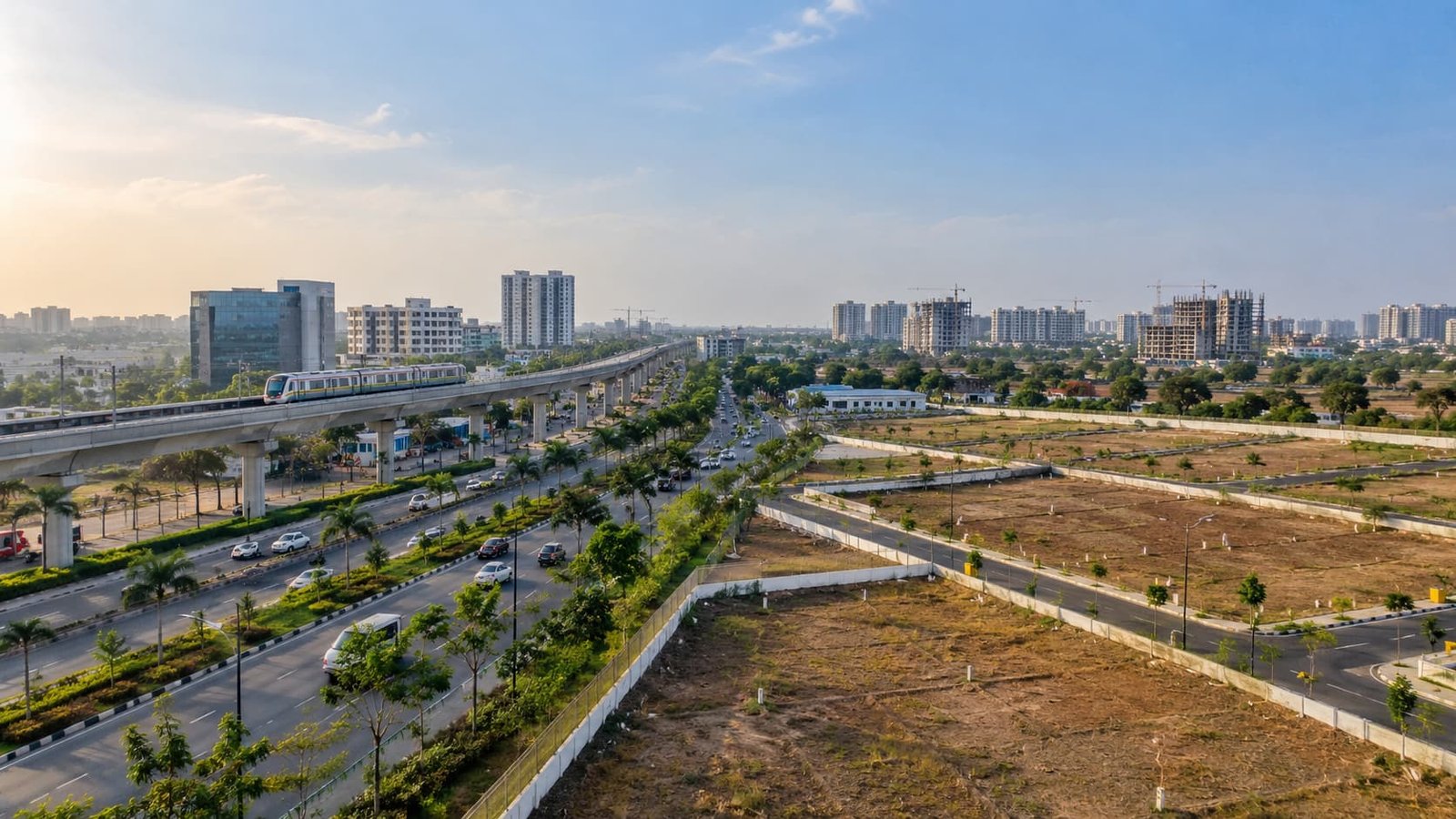
A plot is land. But its value is never determined by land alone.
One of the most common assumptions in real estate is:
“Land is limited, so land prices will always go up.”
It sounds logical, but there is an important part of the equation that buyers often overlook:
How much new developable land is entering the market?
This question is becoming increasingly important as India’s real-estate market expands beyond established city centres and more peripheral locations enter the development pipeline.
Recent land-market research referenced in Siddham’s research notes indicates significant land transaction activity across Indian cities, with residential development accounting for a major share.
For a plot buyer, this creates an important question:
If more land is entering the development pipeline, what exactly should you be paying for today?
You may have heard:
“They aren’t making any more land.”
Technically, that’s true.
But property markets don’t operate based on the total amount of land available. They operate on usable and developable land.
As cities expand, peripheral land can enter the development ecosystem through:
So instead of asking:
“Is land finite?”
A property buyer should ask:
“How much usable residential land could become available in this particular micro-market?”
Land-market activity is increasingly moving beyond India’s largest metros.
Tier-2 markets, including Indore, are becoming increasingly relevant as developers look for locations where four factors can work together:
Land + Infrastructure + Economic Activity + Housing Demand
But increased development activity doesn’t automatically mean every plot will appreciate.
The relationship between supply and demand matters.
Consider three simplified scenarios.
More plots and projects enter the market, while buyer demand grows slowly.
Possible result: Buyers get more choice and projects face greater competition.
New supply enters the market, but employment, population and housing demand expand even faster.
Possible result: The market may continue expanding despite additional supply.
Many projects enter the market without enough genuine end-user demand.
Possible result: Inventory pressure can increase.
Therefore, simply knowing that new land is being developed isn’t enough.
You also need to understand:
Who is going to buy or live there—and why?
People usually don’t move somewhere simply because land is available.
They need a reason to live there.
Demand can be supported by access to:
Study the location’s access to:
Families also need everyday infrastructure such as:
Even a well-connected area needs to remain financially accessible to its intended buyer segment.
Ask:
Can actual households afford to buy and eventually live here?
Infrastructure-led corridors can expand the parts of a city that people and businesses can practically access.
Better roads, Metro networks, industrial corridors and other infrastructure can influence where developers acquire land and where future housing supply emerges.
But remember:
Infrastructure ≠ Guaranteed Appreciation
Infrastructure improves accessibility and can support development.
Whether an individual property performs well depends on many other factors.
Check for:
A market with many competing projects behaves differently from a location with limited comparable supply.
Think about the potential future buyer:
If you cannot identify a realistic future user or buyer, be careful about relying purely on speculation.
Look for genuine differentiation such as:
Suppose someone tells you:
“This area is going to become expensive.”
Your next question should be:
“How much competing supply is coming?”
If thousands of similar plots become available nearby, buyers will have alternatives.
Your plot doesn’t exist in isolation.
And when buyers can compare multiple options, location quality, pricing, development and execution become even more important.
Before buying a residential plot, investigate:
This prevents you from evaluating one project in isolation.
Indore is part of India’s broader Tier-2 urban expansion story.
But buyers shouldn’t interpret that as:
“Indore is growing, therefore every plot is a good investment.”
A better question is:
“Which Indore micro-markets have the strongest combination of genuine demand, sensible supply, infrastructure, connectivity and liveability?”
That’s where micro-location analysis becomes important.
Even two plotted developments within the same broad corridor can have very different characteristics.
For example, Siddham’s project information documents Dream Destination at Palakhedi on Super Corridor, approximately 2.5 km from a Metro station and around 300 metres from the 300-ft Ahilya Path.
Gurudev Avenue, at Junarda Puwarda on Super Corridor, is documented at approximately 3.5 km from a Metro station and around 500 metres from the 300-ft Ahilya Path, with access through a 100-ft-wide entrance road.
The lesson isn’t that one project is automatically better.
The lesson is:
Two properties in the same corridor can have different connectivity, development status and buyer-use characteristics.
That’s why property decisions should happen at the micro-location and project level, not just at the city or corridor level.
Not automatically. The impact depends on how quickly new supply enters the market compared with actual buyer demand.
It depends on the location, purchase price, development quality, demand, documentation and future competing supply.
Factors can include infrastructure-led growth, availability of larger land parcels, housing demand and continued urban expansion.
No. Infrastructure can improve accessibility and development potential, but it does not automatically create scarcity.
Not simply because additional projects are coming. Compare today’s property with current and expected future supply and evaluate whether today’s price makes sense.
The question is not:
“Will land prices go up?”
The better questions are:
How much supply is coming?
Who will create future demand?
What makes this location useful?
And does today’s price make sense based on today’s facts?
A good plot-buying decision should be based on evidence—not assumptions about scarcity.
At Siddham Infra Projects, we believe a property should be evaluated on more than its advertised price.
Study the micro-location.
Understand future supply.
Check connectivity.
Verify development.
Review the documents.
And understand who may actually want to live there in the future.
Planning to buy a plot in Indore?
Talk to the Siddham team to understand the location, compare available options and arrange a site visit before making your decision.