
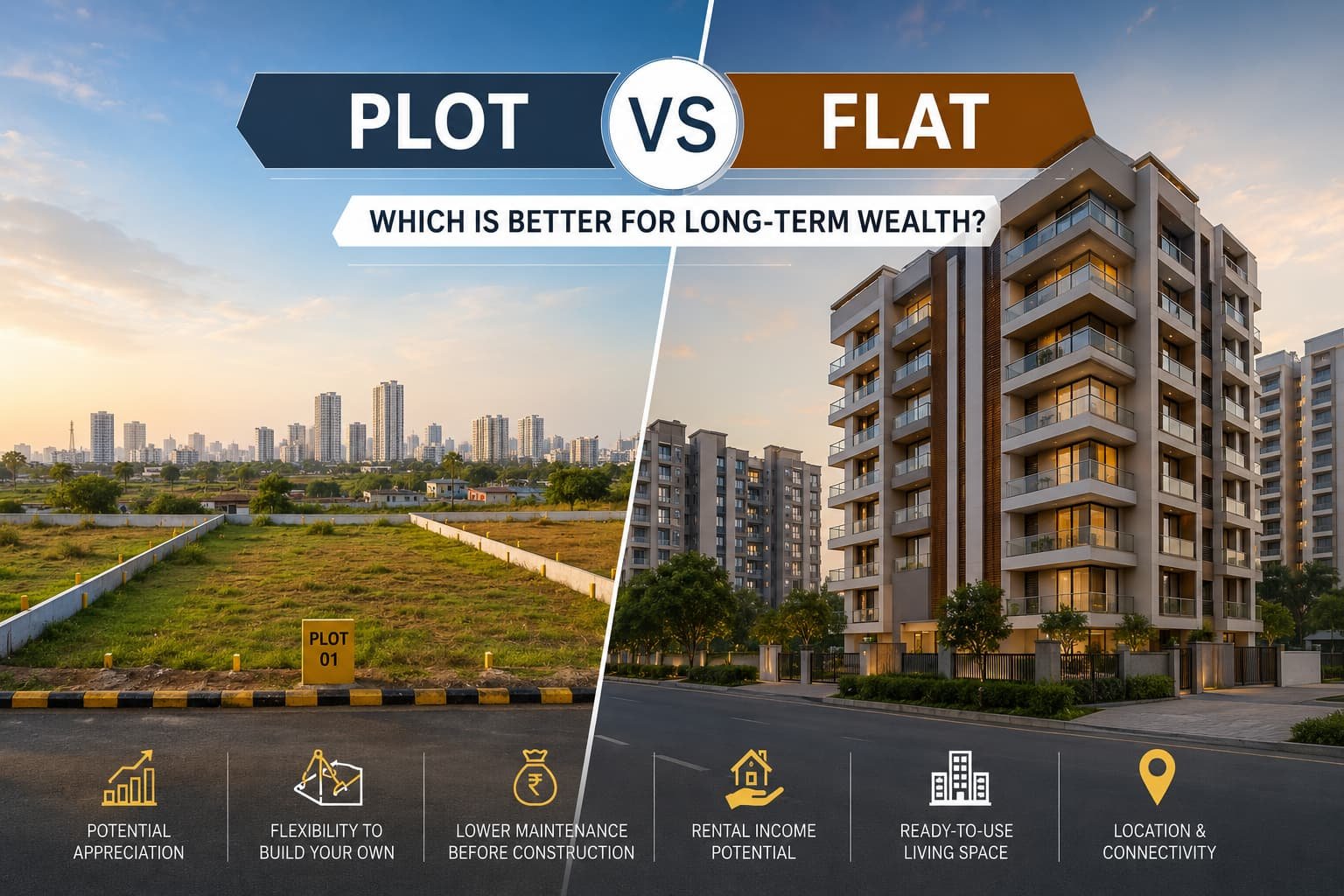
When it comes to property investment, one question almost every buyer asks is:
“Plot lena better hai ya flat?”
If you’re planning a property investment, you’ve probably heard both sides.
One person says:
“Land toh hamesha appreciate hoti hai.”
Another says:
“Flat lo, rent bhi aayega.”
And then someone else says:
“Bas achhi location mein kuch bhi le lo.”
The problem?
All three statements are incomplete.
A plot and a flat are both real estate — but they behave very differently as investments. Your decision shouldn’t simply depend on which option people consider better.
The better question is:
“Mere financial goal ke liye kaunsa better hai?”
That small change in the question can completely change the answer.
Recent 2026 property coverage continues to frame the decision around the investor’s objective — particularly appreciation, rental income, liquidity, financing and holding period, rather than treating one asset as universally superior.
So, before deciding between a plot vs flat investment, let’s understand what you’re actually buying.
A flat gives you:
Land share + constructed property + immediate usability
A plot gives you:
Land ownership + future construction flexibility
That difference matters.
With a flat, you’re buying a completed or under-construction physical structure whose usability can begin relatively quickly.
With a plot, you’re primarily buying the underlying land and the flexibility to decide later what you want to build — subject to applicable approvals and regulations.
So the two assets solve different problems.
When deciding plot or flat which is better, the answer therefore depends first on what you expect your property to do for you.
| Factor | Residential Plot | Flat |
|---|---|---|
| Primary Advantage | Land ownership & flexibility | Immediate built space |
| Rental Income | Generally no, unless developed for income | Potential rental income |
| Construction Flexibility | Higher | Limited to the apartment |
| Maintenance | Usually lower before construction | Regular maintenance |
| Investment Horizon | Often better suited to long-term holding | Can suit shorter/medium-term objectives too |
| Liquidity | Depends heavily on location and demand | Depends on location, segment and property condition |
| Financing | Financing terms vary | Home-loan ecosystem is generally more established |
| End Use | Build later / hold / develop subject to rules | Live / rent / resell |
| Main Risk to Investigate | Title, approvals, location and development | Developer, construction, project, title and marketability |
Important: These are general characteristics, not guaranteed investment outcomes.
Let’s say you buy a flat in an area with strong rental demand.
Once the property is ready and occupied, it can potentially generate:
Monthly rent → recurring cash flow
A vacant residential plot generally doesn’t provide that same rental income.
That’s an important distinction.
If your investment objective is:
“I want monthly income from my property.”
A flat may be the more natural fit.
But rental income isn’t the entire return.
You also need to consider:
So don’t simply compare:
Rent vs zero rent
Compare:
Total return vs total cost.
For buyers considering a flat investment in Indore, rental potential should therefore be evaluated along with the complete cost of owning and maintaining the property.
Now imagine a different buyer.
They say:
“I don’t need rental income today. I want to own land that I can hold for 7–10+ years and potentially build on later.”
For this buyer, a residential plot may be more aligned with the objective.
Why?
Because the buyer isn’t primarily purchasing a ready-made lifestyle product.
They’re purchasing land and future flexibility.
But there’s a crucial condition:
A plot doesn’t become a good investment merely because it is a plot.
The surrounding ecosystem matters:
That’s why “land appreciates” is too simplistic.
The better statement is:
Good land in a location with sustainable demand can become a valuable long-term asset.
This makes location analysis particularly important when considering land vs flat investment in India or a plot investment in Indore.
This is where many property conversations go wrong.
Suppose:
Property A: rises in value.
Property B: gives rent + rises in value.
Which one generated the better investment outcome?
You can’t answer without knowing:
That’s why simply comparing:
“Plot prices went up.”
with:
“Flat prices went up.”
doesn’t tell the complete story.
A serious investor looks at total economics, not just the headline price.
Here’s a simple exercise.
Before buying property, imagine that you cannot sell it for seven years.
Now ask yourself:
Suddenly, the decision becomes much clearer.
A real estate investment in 2026 should therefore be evaluated according to your holding capacity and financial requirements rather than only today’s property price.
Imagine these two people.
They want land today because they eventually want to build their own home.
They don’t need rent immediately.
They care about:
Location + Legal Clarity + Infrastructure + Future Usability + Family Security
For this person, a plot can make considerable sense.
They have investment capital and want an asset that can potentially generate rental income.
They care about:
Tenant Demand + Rent + Occupancy + Maintenance + Resale
For this person, a flat may be more suitable.
Neither buyer is automatically “smarter.”
They’re solving different problems.
This question becomes particularly interesting in a growing city like Indore.
CRISIL’s July 2026 research classifies Indore among India’s Tier-2 cities and reports that residential real-estate demand across its Tier-2 city set grew at a 14% CAGR between FY2021 and FY2026. The report also points to infrastructure and urban growth as important drivers while cautioning that affordability and inventory still need monitoring.
Separately, PropEquity data reported by Business Standard found that Indore was among the leading Tier-2 cities for residential plot launches, with Tier-2 cities accounting for 52% of residential plot supply across the top 10 Tier-1 and Tier-2 cities between 2022 and May 2025.
But here’s the part investors shouldn’t ignore:
A growing city does not mean every property within that city will perform equally.
That’s why location analysis matters more than simply saying:
“Indore is growing.”
The real question is:
“Which locations have the combination of demand, connectivity, infrastructure and usable development?”
Instead of looking for one universal winner, compare both options with your own priorities.
Long-term land ownership
↓
Future construction flexibility
↓
Long holding period
↓
No immediate dependence on rental income
Immediate use
↓
Potential rental income
↓
Established residential ecosystem
↓
Greater need for near-term usability
Again, these are decision tendencies, not guarantees.
There’s another question most people forget.
Don’t only ask:
“Which asset will give me higher returns?”
Ask:
“What kind of return do I actually need?”
Property can provide different kinds of value.
Potential appreciation and income.
Ability to live comfortably in the property.
Ability to build, modify or use the property differently later.
Confidence in ownership and documentation.
An asset that can eventually be passed to the next generation.
For many Indian families, property isn’t only an investment spreadsheet.
It’s also a long-term family decision.
That’s why the “best” property is often the one that fits both the financial objective and the family’s actual life plan.
Instead, start with these five questions:
Investment, home, rental income or future construction?
2 years is a very different strategy from 10 years.
If yes, rental potential becomes important.
If you want to build your own home later, land may offer more flexibility.
Don’t buy a story.
Study the infrastructure, demand, legal position and development around the property.
So…
Plot or flat?
There is no universal winner.
A flat can be the better decision for someone who values immediate usability and potential rental income.
A plot can be the better decision for someone who values land ownership, long-term holding and future construction flexibility.
But neither should be purchased simply because someone says:
“Isme return zyada milega.”
The smarter approach is:
Because in real estate, the right investment isn’t necessarily the property everyone is talking about.
It’s the property that makes sense for your objective.
We believe property decisions should be made with clarity, not pressure.
Whether you’re considering a plot or a flat, understand the location, verify the documents, calculate the complete cost and decide according to your actual objective.
Because the right property decision starts with the right questions.