
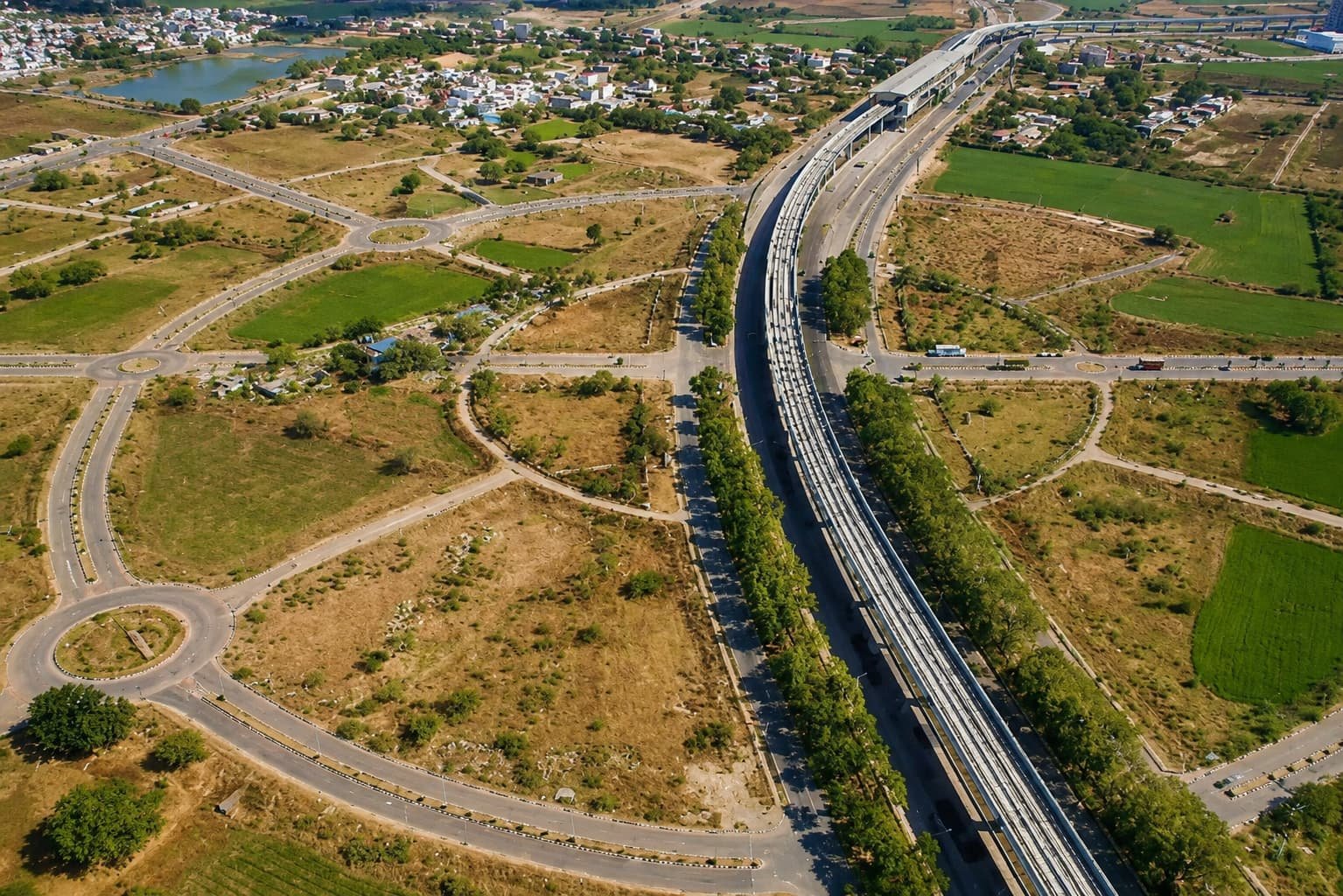
Imagine two plots.
Both are 1,000 sq. ft.
Both are priced similarly.
Both look equally attractive on paper.
But five years later, one location has become a well-connected residential area surrounded by jobs, transport and social infrastructure.
The other is still waiting for the surrounding ecosystem to develop.
So what made the difference?
Often, it isn’t the plot itself.
It is what happened around the plot.
This is why, when evaluating real estate in a growing city like Indore, one question deserves much more attention:
“What is happening around this location?”
When people evaluate a property, the first things they usually compare are:
All of these matter.
But there is another layer that long-term buyers and investors should understand:
Location economics.
A location can become more useful when it gains better connectivity, employment opportunities, public infrastructure, healthcare, education, commercial activity and residential development.
And when more people want to live, work or invest in that area, the real-estate market can change with it.
This is one reason infrastructure-led development has become such an important theme in India’s emerging cities.
CRISIL’s 2026 housing research found that Tier-2 cities recorded strong residential demand growth between FY2021 and FY2026, while also noting that different cities can perform very differently. In other words, simply buying in a Tier-2 city is not enough — the specific location matters.
Indore has been expanding beyond its traditional residential and commercial centres.
Areas connected with major roads, employment hubs, institutional development and new infrastructure are becoming increasingly important when people think about the city’s next phase of growth.
The Super Corridor is a good example of why investors should study ecosystems rather than isolated projects.
The Indore Development Authority continues to list development and land activity in the Super Corridor area, including schemes 151 and 151-169B.
The important takeaway isn’t:
“Buy because Super Corridor will appreciate.”
That would be an assumption.
The more useful question is:
“What infrastructure and economic activity are developing around the corridor, and how could that affect its future usability and demand?”
That is the question a serious property buyer should investigate.
The first thing to study is simple:
How easy is it to reach the location?
Look at:
A location that is physically isolated may remain isolated even if the surrounding city grows.
Connectivity is what connects a development to the city’s economic ecosystem.
This is one of the most overlooked factors.
People don’t simply move toward land.
People move toward opportunities.
When offices, IT companies, industrial clusters, educational institutions and commercial centres develop around a location, they can create demand for housing and supporting services.
That’s why an investor should ask:
“Who will eventually live here — and why?”
Not:
“Kitna rate chal raha hai?”
That second question matters.
But the first question explains why demand may exist in the first place.
A residential location becomes more useful when everyday needs become easier to access.
Think about:
This matters particularly to families.
For a family buying land to build a home, the investment is not just about the plot.
It is about the life that can eventually be built around it.
Large infrastructure projects don’t happen in isolation.
Urban development often involves:
The presence of planned development can be an important signal.
But here’s the important distinction:
A proposed project is not the same as a completed project.
Investors should always distinguish between:
Announced → Approved → Under development → Operational
That one habit can prevent a lot of poor property decisions.
Real estate marketing often sounds like this:
The problem?
A prediction is not evidence.
A smarter approach is to build your own location checklist.
1. What exists today?
Not what is promised. What is actually there?
2. What is under development?
Which infrastructure projects are genuinely moving?
3. What is officially planned?
Look for credible government and authority sources.
4. What economic activity is coming?
Jobs create people. People create housing demand.
5. Who is likely to buy or live here?
End-users and investors can have different motivations.
6. What are the risks?
Development can be uneven. Not every announced project gets delivered on the original timeline. And not every emerging location becomes a successful real-estate market.
Not simply because it is called an “emerging corridor.”
Instead, look for a combination of:
Connectivity + Employment + Infrastructure + Social Development + Legal Clarity + Real Demand
When these factors begin working together, a location can become much more interesting.
But real estate isn’t a one-factor investment.
A great road cannot compensate for poor legal documentation.
A good location cannot compensate for an unclear title.
A beautiful project cannot compensate for weak development execution.
And a low price does not automatically mean a good investment.
If you’re buying a residential plot in Indore for the next 7–10 years, don’t evaluate it only on today’s price.
Evaluate the location’s trajectory.
Ask yourself:
“If I come back to this location five years from now, what could be different?”
Could connectivity improve?
Could employment increase?
Could residential density grow?
Could social infrastructure expand?
Could the area become more convenient for families?
Could demand increase?
And equally importantly:
“What evidence do I have for believing that?”
That’s where intelligent property investing begins.
A plot is a piece of land.
But its long-term potential is influenced by the ecosystem developing around it.
That is why experienced property buyers don’t just study the plot.
They study:
Because sometimes the most important thing about a property…
isn’t what is built on it.
It’s what is being built around it.
At Siddham Infra Projects, we believe buying land should be a decision made with clarity, not pressure.
Before choosing any property, study the location, verify the documentation, understand the development status and evaluate whether the opportunity actually fits your goal.
Because the right property decision starts long before the booking form.
Want to understand the growth story of a particular Indore corridor?
Talk to our team and review the location with us.